
 (1).svg)
 (1).png)


 (1).svg)
.svg)
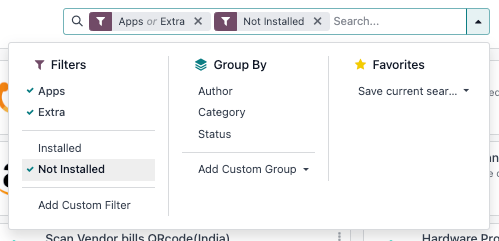
Odoo 18.0 provides a streamlined interface for managing your business applications. From your main dashboard, you can effortlessly install, upgrade, and uninstall any required apps and modules. When navigating to the Apps section, you'll notice that an 'Apps' filter is applied by default, displaying only primary applications. To broaden your search and include individual modules, simply select 'Extra' from the available filter options.
Important Considerations: Managing apps and modules in Odoo can have significant implications for your database and potentially your subscription costs. It is crucial to proceed with caution and thorough planning.
- Database Management Responsibility: The database administrator holds primary responsibility for its operation and configuration. Their understanding of organizational workflows is key to making informed decisions regarding app installations and removals.
- Understanding App Dependencies: Odoo applications often have dependencies. Installing a particular app or feature might automatically install additional apps and modules that are technically essential for its functionality, even if not directly used by database users.
- Testing Apps on a Duplicate Database: Before implementing changes on a live production database, it is highly recommended to test all app installations, upgrades, or uninstallations on a duplicate database. This practice helps identify any unforeseen app dependencies or potential data loss, ensuring the stability and integrity of your primary database. You can learn how to duplicate an Odoo Online database or an Odoo On-premise database through the respective documentation.
Installing Applications and Modules
To install a new application or module, begin by navigating to the main Odoo dashboard and accessing the 'Apps' section. Utilize the search bar to quickly locate the desired application, or simply scroll through the available options. Once you've found the app, click on the 'Activate' button prominently displayed on its card.
Important Note: If a specific app or module you intend to install does not appear in the list, it might require updating the app list. To do this, first activate developer mode. After enabling developer mode, return to the Apps section, and then click 'Update' to refresh the module list, making newly available apps visible.
Upgrading Applications and Modules
With every new Odoo release, enhancements, new functionalities, and improved app features are consistently introduced. To leverage these latest improvements and ensure your applications are up-to-date, it is recommended to upgrade your modules.
To upgrade an application, navigate to the Apps section. Locate the specific app you wish to upgrade, click the vertical ellipsis icon (⋮) on its card, and then select the 'Upgrade' option from the dropdown menu.
Uninstalling Applications and Modules
Warning: Data Loss Imminent! Uninstalling applications in Odoo permanently deletes their associated database records. It is critically important to thoroughly test any uninstallation process on a duplicate database before attempting to remove apps from a live production environment.
Understanding Dependencies: Be aware that many applications have dependencies, meaning they rely on other modules to function correctly. Consequently, uninstalling a single application might lead to the uninstallation of multiple interconnected apps and modules.
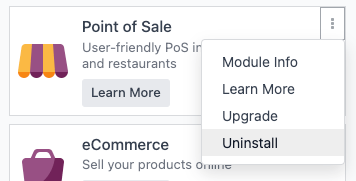
To uninstall an application, go to the Apps section. On the card of the app you wish to remove, click the vertical ellipsis icon (⋮) and select 'Uninstall'. This action will open the 'Uninstall Module' pop-up window, providing a summary of the upcoming changes.
Within this window:
- The Apps to Uninstall section clearly lists all the applications scheduled for removal.
- Pro Tip: To gain a comprehensive understanding of all module dependencies that will be affected, select the 'Show All' checkbox.
- The Documents to Delete section provides a detailed list of all database records that will be permanently erased as part of the uninstallation process.
To finalize the process and proceed with uninstalling the app, its dependencies, and all related database records, click the 'Uninstall' button.
Example of App Dependencies During Uninstallation
Consider a scenario where the Restaurant application is installed. This app fundamentally relies on the Point of Sale application to operate correctly. Therefore, if you choose to uninstall the Point of Sale app, the system will also automatically uninstall the Restaurant app, along with any database records associated with both applications. This demonstrates the critical interconnectedness of modules within Odoo.