 (1).svg)
 (1).png)


 (1).svg)
.svg)
Odoo defines a user as an individual who has access to a specific database. Administrators possess the capability to add as many users as their company requires. To ensure data security and relevance, specific rules can be applied to each user, restricting the type of information they can access. Both users and their associated access rights can be configured and modified at any time to adapt to evolving business needs.
Add Individual Users
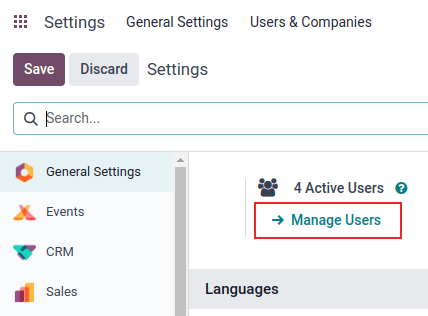
To onboard new users into your Odoo system, navigate to Settings > Users & Companies > Users, and then click on the New button. This action will open a form where you can input the user's details.
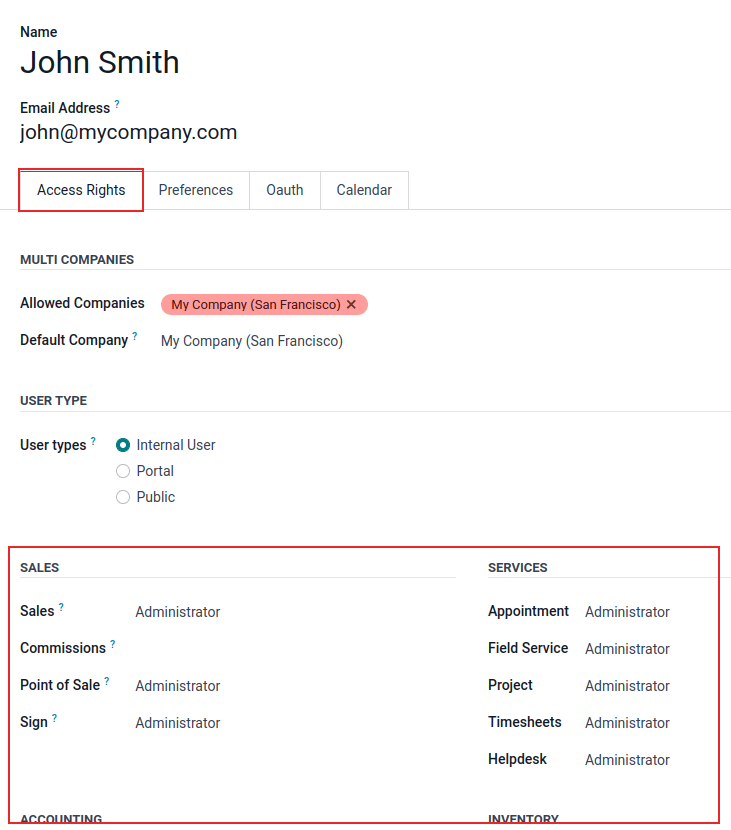
Carefully fill in all the necessary information in the provided form. Within the Access Rights tab, you will need to assign the user to appropriate groups for each application they require access to. This ensures they have the correct permissions for their role.
The list of applications displayed for access rights configuration is dynamically generated based on the applications currently installed within your Odoo database.
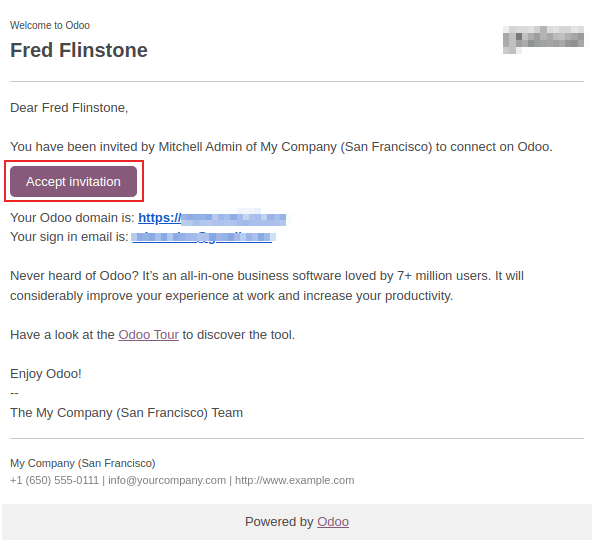
Once all required fields on the user form have been completed, manually Save your changes. An invitation email will be automatically dispatched to the email address provided in the Email Address field. The new user must then click on the link embedded in this invitation email to accept it and establish their login credentials for the database.
Warning
If your company operates on a monthly subscription plan, the Odoo database will automatically update to reflect any newly added users. However, for companies on yearly or multi-year subscription plans, an expiration banner will appear within the database. To update the subscription and accommodate the new users, an upsell quotation can be generated by clicking this banner. Alternatively, you may need to submit a support ticket to resolve any subscription discrepancies.
Understanding User Types
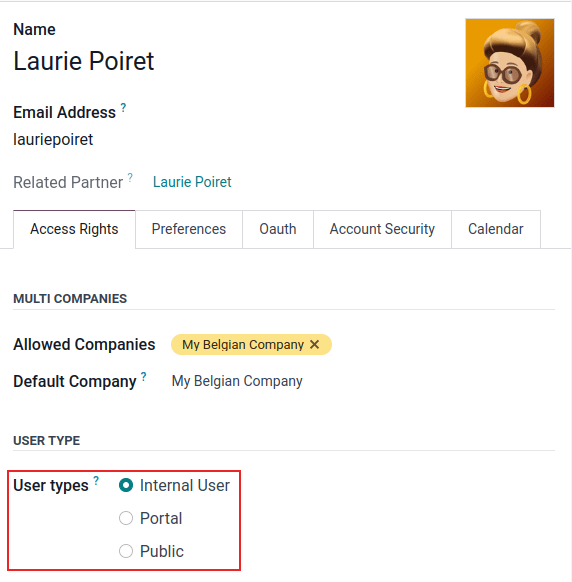
The User Type setting, crucial for defining user access, can be configured from the Access Rights tab on the user form, which is accessible via Settings > Users & Companies > Users.
Odoo categorizes users into three distinct types: Internal User, Portal User, and Public User. Each type is designed for different levels of interaction with your Odoo database.
Tip
Internal users are considered full database users with comprehensive access based on their assigned rights. Portal users, in contrast, are external users who are granted limited access, typically confined to the database portal for viewing specific records. For more detailed information, please refer to the documentation on Portal access.
Public users represent individuals who interact with your Odoo instance via the website's frontend, such as website visitors or unregistered guests.
It's important to note that for both Portal and Public user options, administrators are generally not able to manually choose access rights. These user types come with predefined access rights, including specific record rules and restricted menus, and they typically do not belong to the standard Odoo user groups. This streamlined approach ensures a consistent and secure experience for external and public interactions.
Deactivating Users in Odoo
Should you need to temporarily or permanently remove a user's access, you can deactivate (or archive) their account. To begin, navigate to Settings > Users & Companies > Users. From the list of users, tick the checkbox located to the left of the user(s) you wish to deactivate.
After selecting the appropriate user(s) for archiving, click on the ⚙️ Actions icon. From the resulting drop-down menu, choose Archive. A confirmation pop-up window will then appear; click OK to finalize the deactivation process.
Danger
It is critically important that you never deactivate the main administrator user (often labeled as "admin"). Modifying administrator accounts can have severe detrimental impacts on your Odoo database, potentially leading to an impotent admin state where no user can make changes to access rights. Odoo strongly recommends contacting an Odoo Business Analyst or the Support Team before attempting any changes to administrator accounts to prevent unintended consequences.
Resolving "Too Many Users" Errors
If your Odoo database contains more active users than are provisioned within your Odoo Enterprise subscription, an alert message will be displayed prominently within the system.

Upon the appearance of this message, the database administrator is typically granted a 30-day grace period to address the issue before the database subscription expires. A countdown timer will update daily, indicating the remaining time.
To resolve this situation, you have two primary options:
- Upgrade Your Subscription: Click the "Upgrade your subscription" link displayed in the message. This will allow you to validate an upsell quotation and pay for the additional users required.
- Deactivate Users: Alternatively, you can deactivate existing users to bring the total count within your subscription limits. After deactivating users, you should then reject any pending upsell quotation if you choose not to add more users.
Warning
Similar to adding users, if your company is on a monthly subscription plan, the database will automatically adjust to reflect the updated user count. For yearly or multi-year plans, an expiration banner will appear if the user count is incorrect. You can create an upsell quotation by clicking this banner to update your subscription, or you can send a support ticket to the Odoo team for assistance.
Once your database correctly reflects the provisioned number of users, the expiration message will automatically disappear after a few days, following the next subscription verification cycle.
Managing User Passwords
Effective password management is a critical component of ensuring users have secure and autonomous access to the Odoo database at all times. Odoo provides several convenient methods to facilitate the resetting of a user's password, enhancing flexibility and security.
Tip
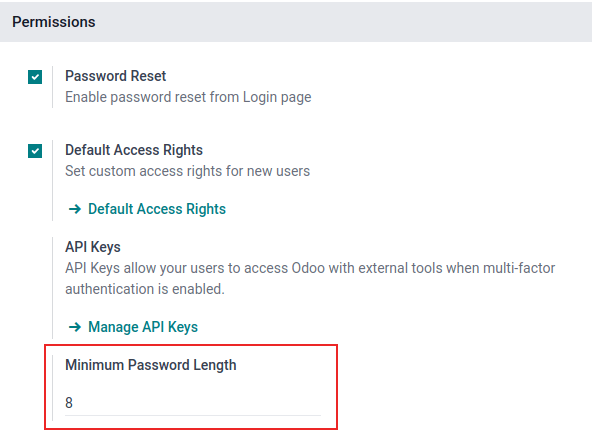
Odoo includes a configurable setting that allows you to specify the minimum length required for user passwords. This setting can be accessed by navigating to Settings > General Settings, and then entering the desired password length in the Minimum Password Length field. By default, this value is set to
8characters.
Password Reset Options
Users may occasionally wish to reset their personal password for enhanced security, ensuring they maintain sole control over their account access. Odoo offers two distinct password reset mechanisms: one initiated directly by the user, and another triggered by an administrator.
Enabling Self-Service Password Reset
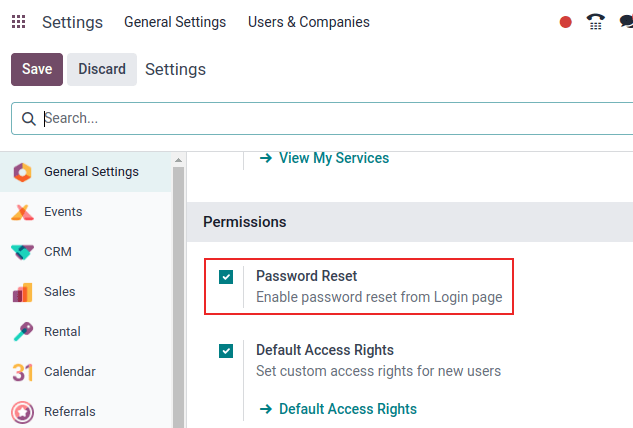
Odoo provides the functionality to enable or disable password resets directly from the login page, allowing users to initiate the process themselves. This self-service option is enabled by default for convenience.
To modify this setting, navigate to Settings > General Settings, activate the Password Reset option under the Permissions section, and then click Save.
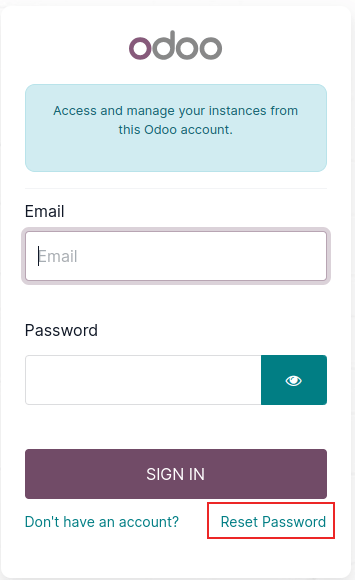
On the Odoo login page, users can click the Reset Password link to begin the password reset procedure. This action will send a unique reset token to the email address associated with their account, guiding them through the steps to create a new password.
Sending Password Reset Instructions (Admin Initiated)
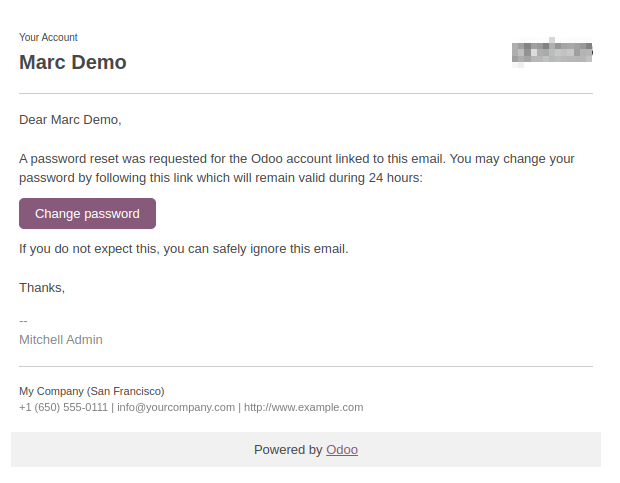
Administrators can also initiate a password reset for a specific user. To do this, go to Settings > Users & Companies > Users, select the desired user from the list, and then click on Send Password Reset Instructions on their user form. An email containing comprehensive password reset instructions will be automatically sent to the user.
Note
The "Send Password Reset Instructions" button will only appear if the initial Odoo invitation email has already been confirmed by the user. If the invitation has not yet been accepted, a "Re-send Invitation Email" button will be displayed instead.
This email contains all the necessary instructions and a secure link that will redirect the user to an Odoo login page, where they can securely establish a new password.
Directly Changing a User's Password
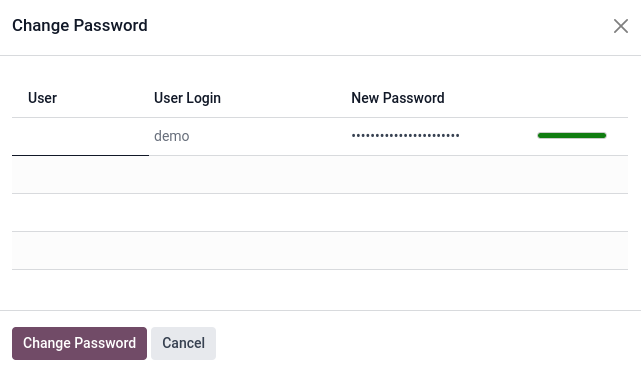
Administrators have the capability to directly change a user's password within the Odoo interface. Navigate to Settings > Users & Companies > Users, and select a user from the list to open their individual user form. Click on the ⚙️ Actions icon, and then select Change Password from the resulting drop-down menu. In the "Change Password" pop-up window that appears, enter a new password in the New Password field and confirm the change by clicking Change Password.
Note
This operation exclusively modifies the user's password within your local Odoo database and does not impact their associated odoo.com account password. If the odoo.com password requires modification, the user must utilize the send password reset instructions feature. Odoo.com passwords grant access to the My Databases page and other portal-specific features.
After successfully clicking Change Password, the system will redirect the page to an Odoo login screen. The user can then re-access the database using their newly established password.
Configuring Multi-Company Access for Users
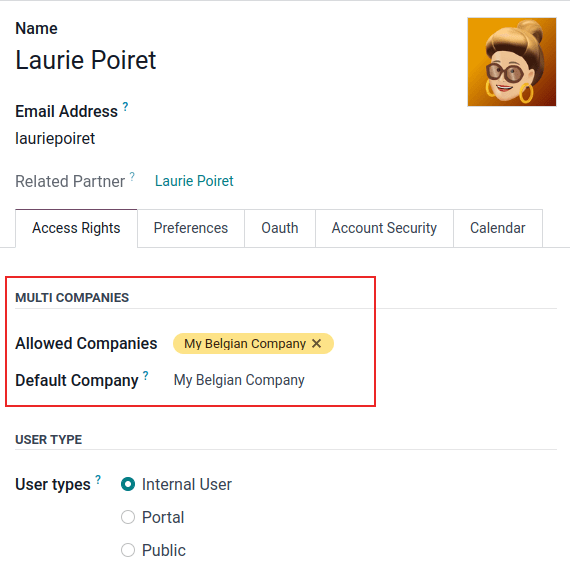
The Multi Companies field on a user form empowers an administrator to grant specific users access to operate across multiple companies within a single Odoo instance. To set up a multi-company environment for a user, begin by navigating to the desired user's profile through: Settings > Users & Companies > Users. Select the user to open their user form, where you can then configure their multi-company access settings.
Within the Access Rights tab, locate the Multi Companies section and configure the fields labeled Allowed Companies and Default Company.
- The Allowed Companies field can contain multiple company selections. These are the companies that the user is authorized to access and modify, subject to their defined access rights.
- The Default Company field specifies the single company that the user will automatically default to upon logging in each time. This field can contain only one company.
Warning
Improper configuration of multi-company access can lead to inconsistent and potentially problematic behaviors across your Odoo database. Therefore, it is strongly advised that only experienced Odoo users make changes to user access rights in databases configured for multi-company operations. For in-depth technical explanations and best practices, please refer to the developer documentation on Multi-company Guidelines.