
 (1).svg)
 (1).png)


 (1).svg)
.svg)
This guide offers detailed instructions on effectively utilizing Docker within your server management environment. Docker, a robust platform for containerized applications, enables the deployment and management of specific software—such as Redis or MongoDB—or particular software versions that might not be natively supported by your operating system or require complex compilation processes. Available as an extension, Docker facilitates the seamless execution and management of containers built from various Docker images, supporting operations on both local and remote host environments. Throughout this document, you will discover how to efficiently create, configure, and manage Docker containers, alongside detailed procedures for controlling remote Docker hosts directly from your administrative interface.
Requirements and Considerations
Warning: The Docker extension downloads images from Docker Hub in their original configuration, without any pre-settings. It is crucial to understand that some Docker containers or the software encapsulated within them are designed for trusted environments only and may necessitate additional security configurations. Before launching these downloaded images, it is imperative to independently enhance their security measures. For specific instructions and best practices, always refer to the official documentation provided by the container or software vendor. For instance, detailed security guidance can often be found in the respective software's documentation.
- Docker is supported across a wide range of operating systems, including CentOS 7, Red Hat Enterprise Linux 7, Debian 10, Debian 11, Debian 12, Ubuntu 18.04, Ubuntu 20.04, Ubuntu 22.04, Ubuntu 24.04, AlmaLinux 8.x, AlmaLinux 9.x, Rocky Linux 8.x, and Virtuozzo 7 with Update 1 Hotfix 1 (7.0.1-686) or a later version. This broad compatibility ensures that many users can leverage Docker's capabilities.
- It is not feasible to utilize Docker within an instance that is itself deployed in a Docker container. This nested containerization is not a supported configuration for the Docker extension.
- Accessing and managing remote Docker services from the control panel requires specific licensing. This ensures that enhanced security and management features for remote operations are properly provisioned.
- Docker is specifically engineered to operate on x64 systems, which means environments running on different architectures will not be able to use this functionality.
- Direct migration or backup of Docker containers within the control panel is not supported. Users must employ alternative strategies for data protection. However, you can effectively back up the data utilized by these containers through volume mapping, as further detailed in the "Volume Mapping" section. This approach allows for persistent data storage separate from the container's lifecycle. Alternatively, downloading container snapshots provides a point-in-time recovery option.
- Virtuozzo 7 with Update 1 Hotfix 1 (7.0.1-686) or a later version offers full support. It is important to note that with this update, new CentOS 7-based containers are created with the firewall enabled by default, which is a reflection of Virtuozzo's enhanced security protocols. Administrators must manually configure the firewall to ensure that all necessary ports for administrative operations are open, thereby maintaining connectivity and functionality.
Prerequisites for Docker Integration
Before you can begin to harness the powerful functionalities of Docker, the Docker extension must be successfully installed on your server. This foundational step is crucial for enabling all subsequent Docker operations. Please follow these guidelines to ensure a smooth setup:
- As an administrator, you typically have the ability to install the extension directly from the Extensions Catalog within your administrative interface. This provides a straightforward method for integrating Docker.
- Alternatively, if you are not the administrator, it is recommended to contact your hosting provider and request that they install the Docker extension for your environment. They will have the necessary permissions and expertise to complete this installation.
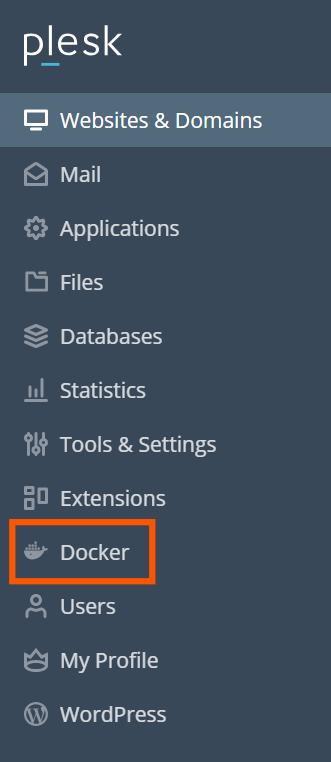
Once the Docker extension has been successfully installed and activated, you are ready to proceed with container management. The "Docker" option will become clearly visible and accessible within the Navigation Pane of your administrative interface, signifying that the setup is complete and operational.
Managing Containers
You can readily access a vast collection of images from Docker Hub directly within the Run Container catalog. This comprehensive catalog serves as your gateway to a multitude of pre-built container images, simplifying the deployment of various applications. The catalog can be conveniently located by navigating to the Docker section, then selecting Containers, and finally clicking on Run Container.
To access the catalog and begin the process of selecting and deploying images:
- If you have not previously installed any containers, you can simply click Run Container directly within the Docker > Containers section to initiate your first deployment.
- Should you have previously installed containers, click the intuitive plus icon
 to open the catalog and explore additional images.
To efficiently view the available images, utilize the integrated search box provided within the interface. This feature allows you to quickly narrow down your options.
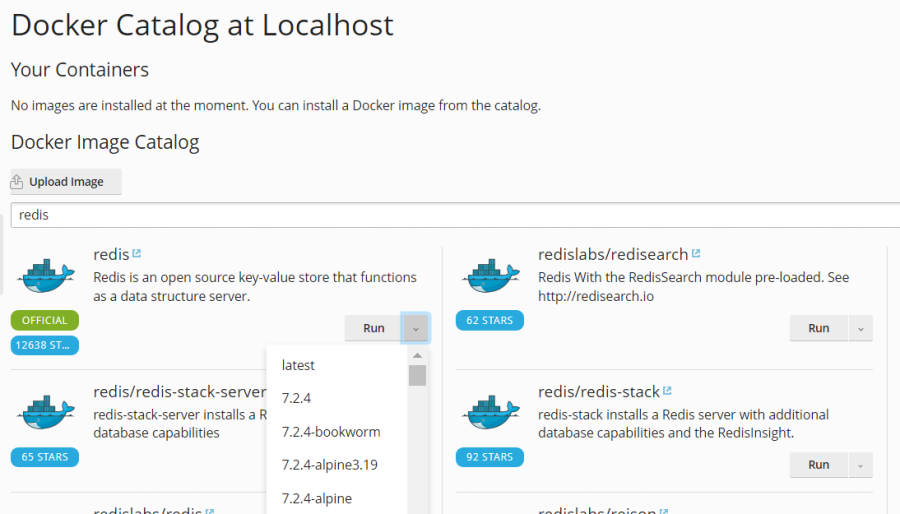
You can refine your search results by specifying either the image name, the repository, or a combination of both. This precision helps in finding the exact container image you need.
The following repositories are available for searching:
- Local repository: This repository contains images that have already been downloaded and are currently stored on your server, managed by Docker. These local images offer faster deployment times and reduce reliance on external network connectivity. For more in-depth details, please refer to the "Managing Local Images" section later in this document.
- Docker Hub: This is the official public registry for Docker images, offering an extensive collection of both official and community-contributed images.
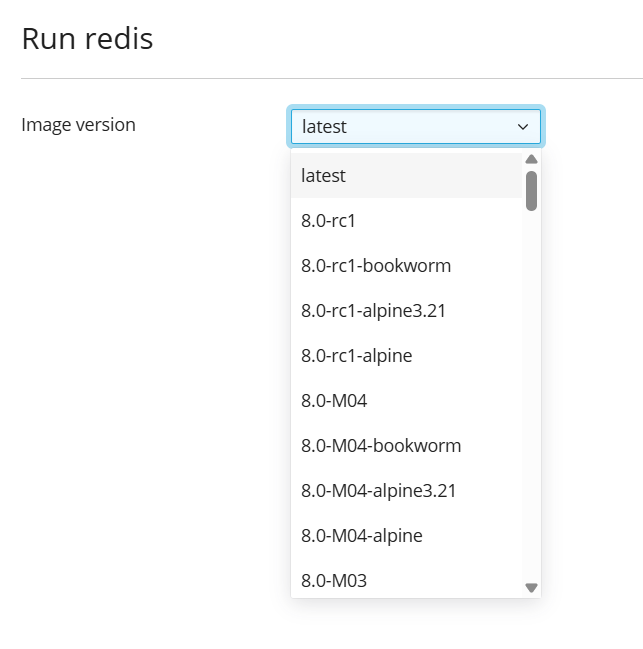
Multiple versions of each application may be available within the catalog. To ensure you are deploying the correct iteration, you can run a specific version by carefully selecting the appropriate tag from the dropdown menu, as clearly illustrated below:
To run a container using a selected image, follow these steps:
- Navigate to Docker > Containers > Run Container.
- Utilize the search box to efficiently locate your desired images within the comprehensive catalog. If an image is already stored locally on your server, the designation "(local)" will be clearly indicated after its version, signifying its ready availability.
- To view the image's detailed description and access its comprehensive documentation on Docker Hub, click the more info icon
 . This valuable option provides insights directly from the image's maintainers and is not applicable for images that are exclusively local.
 - Click on the image card to proceed with your selection.
- To run a specific image version, first select your desired version from the Image version drop-down menu and then click Next.
- To run the latest available version of the chosen application, simply click Next to proceed.
The system will then initiate the container creation process and prompt you to specify its initial settings, such as environment variables, before the container is actually run. You retain the option to cancel this process at any point by clicking Cancel on the Settings screen, allowing for flexibility in your deployment. For comprehensive information regarding these crucial settings, please refer to the "Container Settings" section located further down this page.
- After carefully adjusting the settings as needed to match your application's requirements, click Run. The newly created container will then be prominently displayed in the list within the Containers tab, clearly indicating that it is operational and ready for use.
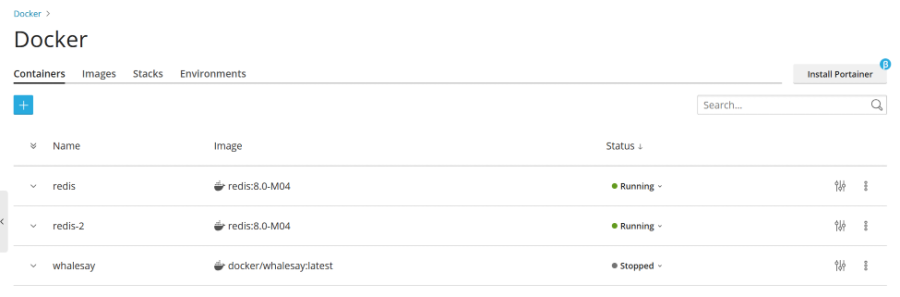
It is always recommended to review the Console Log immediately after deployment to ascertain if the container is running without encountering any issues or errors. This proactive step helps in diagnosing and resolving potential problems swiftly.
Configuring Container Settings
Note: You do not need to halt a container's operation to modify its settings. When you save new configurations, the system intelligently recreates the container with the updated parameters. This sophisticated process ensures minimal downtime and maintains the continuous availability of your applications.
To adjust or edit the settings of an existing container, navigate to the Containers tab and click the settings icon  positioned next to the specific container you wish to modify. This action will open the configuration interface for that container.
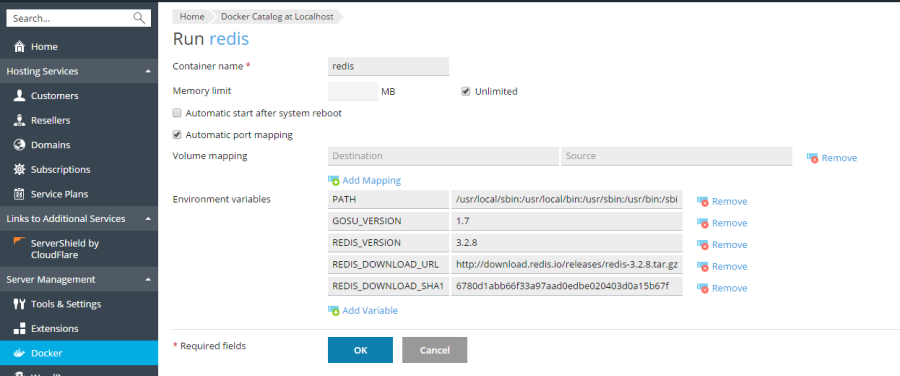
Limiting Container Memory
By default, Docker containers are provisioned to operate with an unlimited amount of RAM, allowing them to consume as much memory as needed by the application. To impose a specific memory constraint and manage resource consumption more effectively on your host system, select the Memory limit checkbox and input your desired limit value in megabytes within the designated MB field. This helps prevent a single container from monopolizing system resources and ensures overall stability.
Note: Currently, direct limitations on CPU and disk usage for Docker containers cannot be configured through this graphical interface. Docker containers are treated as administrator-level objects and, as such, are not governed by subscription-level cgroup limits for CPU, RAM, or disk usage. Further resource management might require command-line interventions.
Automatic Start Configuration
The Automatic start after system reboot option dictates whether a container will automatically resume operation following a server restart. If this option is not enabled, any websites or services relying on this container might become temporarily unavailable after a system reboot. In such scenarios, you would be required to manually restart the container to restore its functionality and ensure your applications are accessible again. Enabling this option is crucial for maintaining high availability.
Understanding Port Mapping
Initially, Automatic port mapping is enabled by default. This convenient feature means that the container's internal port is automatically mapped to a randomly assigned, available port on the host system (e.g., a port like 32768). This simplifies initial deployment but might not be ideal for consistent external access.
To change the port on the host system to a specific, well-known, or preferred port, deselect the Automatic port mapping option. Subsequently, you can specify an alternative external port in the Manual mapping field. If the Manual mapping option does not appear after deselection, it indicates that the container does not expose any internal ports for external access, meaning it might be designed for internal communication only.
When employing manual mapping, Docker, by default, only binds to the specified port on the host system’s localhost interface (127.0.0.1). This configuration inherently makes the port inaccessible from the Internet, thereby providing a crucial layer of security that safeguards the application running within the container from direct external attacks. To allow Docker to bind to the specified port across all network interfaces of the host system, deselect the Make the port inaccessible from the Internet option. Be advised that doing so will make the application inside the container accessible from the Internet via any of the host system’s IP addresses on the designated port, requiring careful consideration of security implications.
Warning: Docker typically operates under the assumption that authentication mechanisms are handled by the application itself. However, this is not universally true (for example, while some databases like MySQL/MariaDB restrict anonymous access by default, others like Redis may not). Exposing an application within a container to the internet without robust, built-in authentication can inadvertently expose it to malicious actors and introduce significant security vulnerabilities, making it imperative to implement proper access controls.
Implementing Volume Mapping
Docker volumes represent dedicated directories on your server that are specifically mounted into a Docker container. This mechanism provides essential persistent storage, allowing data to persist independently of the container's lifecycle. This means that data stored within Docker volumes remains intact and accessible from your host system even when you stop, delete, or recreate a container, ensuring data longevity and integrity.
Warning: It is critically important to understand that data stored within Docker volumes will not be automatically included in standard administrative backups. To prevent any potential data loss of critical information, it is highly recommended to implement a robust third-party backup solution specifically for any essential data residing in a Docker volume. This ensures comprehensive data protection beyond the scope of routine system backups.
For more comprehensive and in-depth information regarding effective data management strategies within containers, it is advisable to consult the official Docker documentation pertaining to volumes. This resource offers detailed insights and best practices.
To establish a volume mapping, you need to specify the following key parameters:
- In the Host field: Provide the absolute path to the directory on your server that you intend to mount into the container. This directory will serve as the persistent storage location.
- In the Container field: Provide the absolute path to a specific directory inside the container where the host directory will be mounted. This is the path the application within the container will use to access the data.
To map additional directories and further enhance your container's data management capabilities, simply click Add one more to create new volume mapping entries.
Setting Environment Variables
Environment variables play a crucial role in configuring the application running inside a container. They provide a flexible way to pass configuration settings to your application at runtime without altering the image itself. You may frequently need to add new variables or modify existing ones to tailor the application's behavior to your specific operational requirements. The administrative interface offers the flexibility to add as many environment variables as your application requires, allowing for highly customized deployments.
Operations with Docker Containers
The administrative interface provides a comprehensive suite of operations designed to help you effectively manage your Docker containers. These tools enable you to control the lifecycle and configuration of your containerized applications with ease:
- You can effortlessly stop (Stop), start (Start), or restart (Restart) any container as needed. In each of these scenarios, the container will be intelligently recreated using its current settings, ensuring consistency and responsiveness.
Note: If you have not critically important data to mounted volumes (as discussed in the "Volume Mapping" section), this data will unfortunately be lost upon container recreation. Always ensure persistent data is stored in volumes.
- To access detailed logs, which are invaluable for debugging and monitoring, and to keep an eye on resource consumption, click the arrow
 positioned conveniently next to the specific container you wish to inspect.
 - To modify container settings, such as environment variables, resource limits, or volume mapping, click the settings icon adjacent to the container you intend to configure. This opens the container's detailed settings panel.
- You can easily rename a container for better organization and identification by navigating to its settings (Settings > Container name) and providing a new, descriptive name.
For additional advanced operations and more granular control over your containers, click the more options icon  located next to the container. This menu reveals a range of powerful functionalities, including the ability to:
- Recreate a container, either using its existing image version or selecting a different one (Recreate), which is useful for updates or rolling back versions.
- Create a new image based on your customized container settings (Save as Image), allowing you to capture specific configurations for reuse.
- Capture a snapshot of your container's current state (Download Snapshot), providing a backup or a reproducible state.
- Permanently remove a container (Remove), freeing up system resources.
Recreating a Container
Recreating a container is a frequently necessary operation, typically performed when you need to update the application it hosts to a newer version, apply security patches, or even revert to an older, more stable release. This powerful functionality allows you to rebuild a container using any application version available in the catalog, not exclusively the very latest one. Crucially, all custom settings that you have applied to the container, such as environment variables and port mappings, are carefully preserved during the recreation process, minimizing manual configuration efforts.
To ensure the complete preservation of data utilized by the application within the container, it is absolutely essential to establish volume mapping before initiating a recreation. Volume mapping grants you persistent access to the directories utilized inside a container, ensuring that valuable data remains intact across container lifecycles. This critical aspect is detailed further in the "Volume Mapping" section within container settings.
To effectively recreate a container, follow these steps:
- Go to the Docker section and click the more options icon located next to the specific container you wish to recreate.
- Click Recreate within the container settings menu. You will then be prompted to specify the desired image version for the new container and to confirm whether to use the default environment variables or your previously configured custom ones.
Utilizing Remote Docker Environments
By default, the platform utilizes Docker installed as a local service on the same server, offering immediate and convenient containerization. However, for enhanced flexibility and scalability, you have the option to integrate one or more external Docker services. This allows you to manage containers across different physical or virtual machines. It is important to note that only one remote Docker service can be actively managed at any given time from your administrative interface. The currently active server is always clearly identified in the "Environments" tab of the Docker settings page within the platform.
Note: Managing remote Docker services requires a specific add-on for your license key. Without this add-on, your management capabilities will be limited exclusively to the local Docker service running directly on the server, restricting access to external Docker hosts.
Configuring Remote Services for Integration
To properly prepare a remote server running Docker for seamless integration with your administrative interface, you must configure it to enable secure and reliable communication. This involves setting up the Docker daemon to accept remote connections, ideally with TLS encryption for security. You should configure it as described in the official Docker documentation on daemon socket options to ensure it can be effectively used as a remote server.
Managing Remote Services from the Interface
You can establish and manage a secure connection between your server (where the Docker extension is installed) and a remote node that hosts a Docker service. The following detailed steps are applicable for both Linux and Windows environments, ensuring broad compatibility for remote Docker management.
Perform these preparatory steps on the remote host where Docker is running:
- Create the
/etc/docker/daemon.jsonconfiguration file for Docker with the following content. This essential configuration enables TLS (Transport Layer Security) for secure communication and meticulously specifies the necessary certificate paths, ensuring that all interactions are encrypted and authenticated:{ "hosts": ["tcp://0.0.0.0:2376", "unix:///var/run/docker.sock"], "tls": true, "tlsverify": true, "tlscacert": "/root/ca.pem", "tlscert": "/root/server-cert.pem", "tlskey": "/root/server-key.pem" } - Prepare the essential
.pemfiles, which are crucial for establishing TLS communication. You can effectively utilize the following example to generate these vital files. Remember to meticulously replace the IP address on line 4 of the script with the actual IP address of your remote Docker node, and then execute each command sequentially to ensure proper certificate generation and setup:openssl genrsa -aes256 -out ca-key.pem 4096 openssl req -new -x509 -days 365 -key ca-key.pem -sha256 -out ca.pem openssl genrsa -out server-key.pem 4096 openssl req -subj "/CN=192.0.2.1" -new -key server-key.pem -out server.csr openssl x509 -req -days 365 -sha256 -in server.csr -CA ca.pem -CAkey ca-key.pem -CAcreateserial -out server-cert.pem openssl genrsa -out key.pem 4096 openssl req -subj '/CN=client' -new -key key.pem -out client.csr openssl x509 -req -days 365 -sha256 -in client.csr -CA ca.pem -CAkey ca-key.pem -CAcreateserial -out cert.pem chmod 0400 ca-key.pem server-key.pem key.pem chmod 0444 ca.pem server-cert.pem cert.pem - Execute the following commands to modify the current Docker service configuration. These commands are essential for ensuring that the Docker service starts automatically and correctly after any host configuration changes, thereby maintaining continuous operation and reliability:
cp /lib/systemd/system/docker.service /etc/systemd/system/ sed -i 's/\ -H\ fd:\/\///g' /etc/systemd/system/docker.service systemctl daemon-reload systemctl restart docker - Save the outputs of the following files from your remote machine to your local machine. These critical files—the client key, client certificate, and CA certificate—are absolutely necessary for the client (your administrative interface) to establish a secure and authenticated remote connection with the Docker service:
cat key.pem
cat cert.pem
cat ca.pem
Now, on the local server where your administrative interface is installed, configure the Docker remote host:
- Navigate to Docker > Environments.
- Click Add Server and input the connection settings for the remote server running Docker, including the certificates obtained in the previous step. This establishes the secure link.
- To immediately begin using this specific Docker service within your administrative interface, ensure that Set active remains selected. This will make it the primary Docker environment.
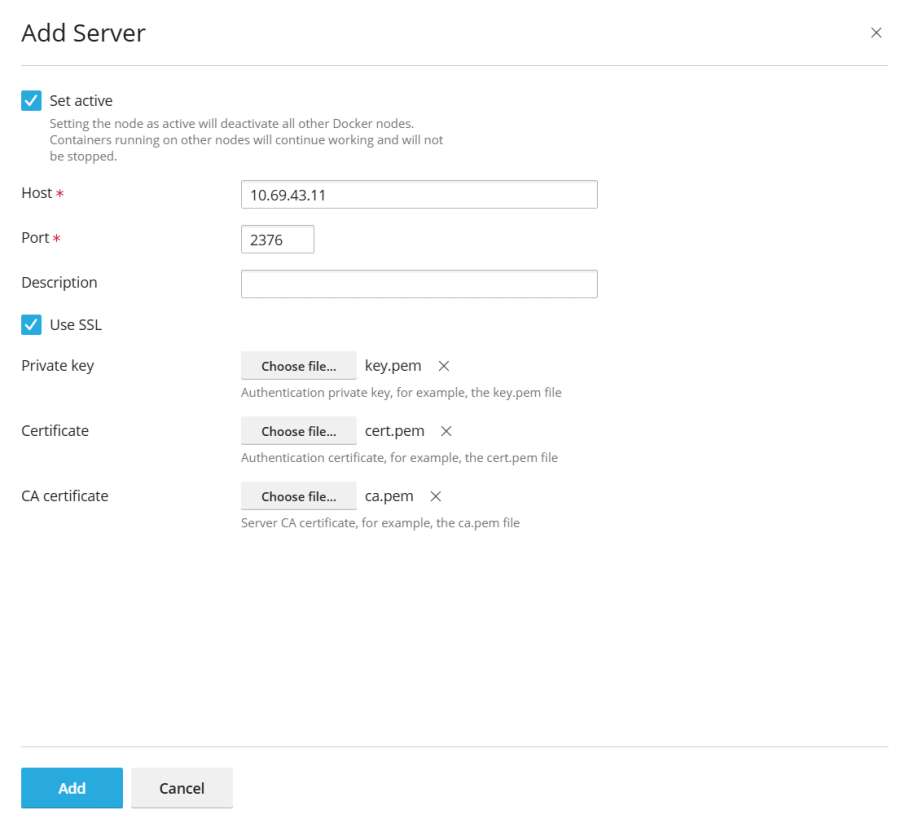
Once successfully configured, a direct link to the active Docker service will appear conveniently in the Navigation Pane, providing quick access to your remote environment.
To switch between different Docker services, whether local or remote, follow these steps:
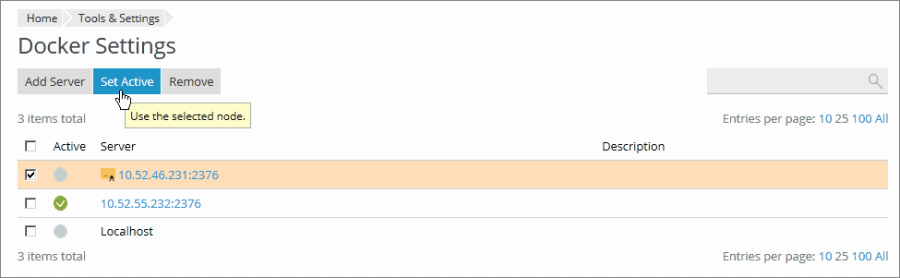
- Go to Docker > Environments.
- From the comprehensive list of available servers, simply select the desired Docker node you intend to use and click Set Active. This action will switch the primary Docker environment.
Alternatively, you can also set a Docker node as active directly while editing its settings, offering another convenient method for managing your Docker environments.
Creating Images with Custom Settings
If you have made specific modifications to a container, such as installing new software, adjusting configurations, or adding data, and wish to save those changes as a new, reusable image, utilize the Save as Image command. This powerful operation essentially captures a precise snapshot of your customized container, including all modifications, which then appears as a distinct new image in your local image catalog. This feature is particularly invaluable for creating custom images with specific configurations, such as pre-set environment variables or pre-installed dependencies, that are perfectly tailored to your application's unique needs and can be deployed consistently across multiple instances.
To create a new image from one of your existing, modified containers, follow these steps:
- Navigate to the Docker section, then select Containers.
- Click the more options icon located next to the container from which you want to create an image, and then click Save as Image from the expanded menu.
- In the Save <container name> as Image side panel that appears, you will need to specify the following crucial details:
- The desired Image name, which should be descriptive and help identify the image's purpose.
- An optional Tag, which can be used to denote the image version, environment, or any other relevant differentiator (e.g., "v1.0", "production", "staging"). By default, if no tag is explicitly provided, the version will be automatically set as “latest”.
The newly created image will then prominently appear in the Images tab and will be clearly marked as a Local image, indicating that it is stored on your server and ready for immediate deployment.
Managing Local Images Effectively
Local images are Docker images that are directly stored on your local disk. This local storage offers significant advantages, as it eliminates the need to download them repeatedly from the online Image Catalog for every deployment. This optimization drastically improves deployment times, reduces network bandwidth consumption, and lessens reliance on external network connectivity, making your operations more efficient and robust.
An image typically becomes a local image under the following circumstances:
- You have selected any version (tag) of an image from the catalog, and the download process has commenced. Even if you subsequently run a container or cancel the operation on the "Settings" screen, the image data will have been saved locally, ready for future use.
- You have manually uploaded an image to Docker within your administrative interface using the Upload image option in the Docker Images tab. This allows for direct import of pre-built images.
- You have successfully created a custom image based on an existing container, as detailed in the "Creating Images with Custom Settings" section. These custom images are inherently local.
- You have built an image using the command-line interface directly on the server. Such images are automatically stored locally.
To download an additional version of an image from the online catalog, click the Pull icon  . Then, select the specific version you wish to pull from the convenient drop-down menu and finally click Pull to initiate the download and local storage.
If Docker detects at least one downloaded version belonging to a group of images, that image will be clearly labeled as a Local image in the catalog, making it easy to identify locally available resources. The administrative interface also conveniently displays how many local images exist for a particular product, providing an overview of your local image inventory.

To efficiently view and remove outdated or unnecessary local images, thereby reclaiming valuable disk space, follow these steps:
- Navigate to Docker > Images.
- To quickly locate a specific local image among your stored collection, use the integrated Search bar.
- To view all local images associated with a particular product, click the link situated conveniently under the product name. This action will comprehensively display all local images' tags and the precise amount of disk space they currently occupy, helping you make informed decisions about cleanup.
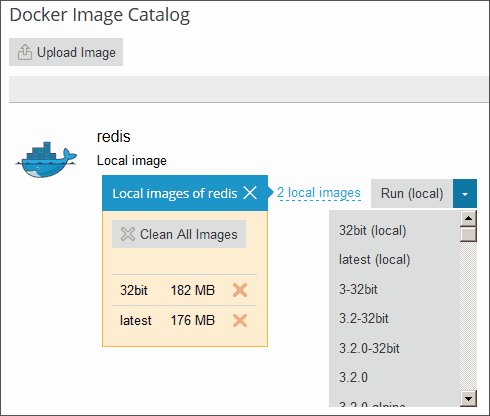
After reviewing, select the specific image(s) you intend to remove and then click Remove to free up disk space and maintain an organized image repository.
Setting up Nginx to Proxy Requests from Domains to a Container
Many Docker containers are meticulously configured to expose specific ports, which allows the applications running within them to be externally accessible via those designated ports. When integrating an application running in a Docker container with your website, it can often be inconvenient and cumbersome for users to remember and manually specify a non-standard port in the URL (e.g., yourdomain.com:8080). This can lead to a less intuitive user experience.
To significantly enhance user experience and simplify access, you can strategically configure Nginx to proxy requests originating from your domains directly to the container's exposed port. This intelligent setup allows your domains to continue using standard web ports (such as 80 for HTTP or 443 for HTTPS) without requiring users to explicitly include the port number in the URL. Essentially, Nginx acts as an intermediary, forwarding traffic seamlessly.
Requirements for Nginx Proxying
- Nginx must be actively running and properly configured within your environment to handle web traffic.
- You must have manually mapped the internal port of the container to a specific, exposed port on the host system (for instance, a port like 32768). This manual mapping is crucial for Nginx to know where to direct the traffic.
To manually map the port inside a container, follow these steps:
- Go to Docker > Containers and click the settings icon next to the container you wish to configure for proxying.
- Disable the Automatic port mapping option. This gives you granular control over port assignments.
- Manually map the internal port of the container to a specific port on your host system (for instance, 32768). You retain the important option to make this host port inaccessible from the Internet for enhanced security, ensuring that direct external access is blocked if desired.
Once the port is manually mapped and secured as per your requirements, you can proceed to configure Nginx to proxy requests from your domains to this specified port on the host system. To achieve this, you will need to add a new rule directly within the domain's settings, linking the domain's URL to the container's exposed port.
To add a proxy rule for Nginx in the domain settings, follow these detailed steps:
- Navigate to Websites & Domains, then select your specific domain. From there, go to Docker Proxy Rules and click Add Rule.
- Specify the following crucial details for the new rule:
- URL: Define the URL of the website or a specific path within it that utilizes the application running in the Docker container. This can be the main website's root (e.g.,
/) or a particular subdirectory (e.g.,/app/). - Container: From the available options, select the Docker container that is hosting the application you wish to proxy.
- Port: Choose one of the port mappings previously defined in the container's settings. This will be the internal container port that is mapped to a port on your host system. Nginx will then proxy incoming requests to this designated host port, seamlessly directing traffic to your containerized application.
- URL: Define the URL of the website or a specific path within it that utilizes the application running in the Docker container. This can be the main website's root (e.g.,
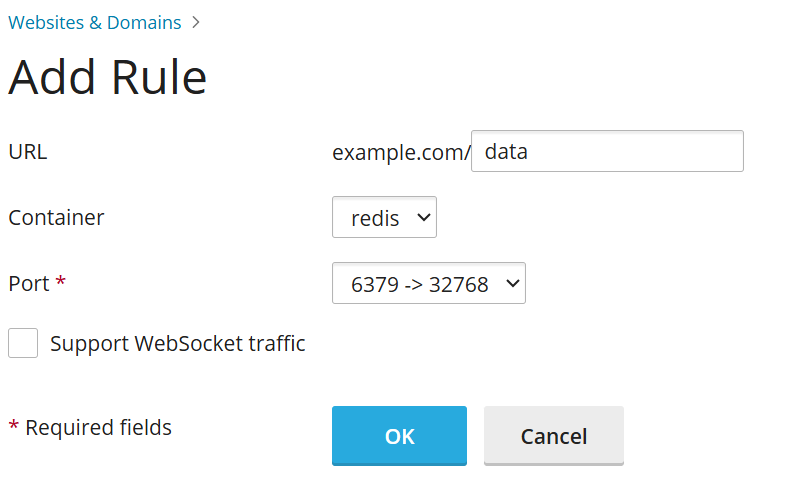
These proxy rules are intricately implemented directly within the web server configuration, typically found in the website’s nginx.conf file, which is usually located at a path similar to /var/www/vhosts/system/$domain/conf/. The configuration block will resemble the following, indicating the proxying behavior:
#extension docker begin
location ~ ^/.* {
    proxy_pass http://0.0.0.0:9080;
    proxy_set_header Host             $host;
    proxy_set_header X-Real-IP        $remote_addr;
    proxy_set_header X-Forwarded-For  $proxy_add_x_forwarded_for;
}
#extension docker end
It is noteworthy that these proxy rules are meticulously designed to function seamlessly and reliably even on servers operating behind Network Address Translation (NAT) environments, ensuring broad applicability.
Note: Docker containers that are connected to a website via Proxy Rules are generally not included in the subscription’s disk space usage calculations. An exception to this occurs if a website directory is directly mounted into a Docker container as a volume; in this specific scenario, all files located within that container will be accounted for in the website's overall disk space usage, requiring careful monitoring.
Deploying Applications with Docker Compose YAML Files
The platform provides a highly streamlined and efficient method for deploying complex applications defined by Docker Compose YAML files. Docker Compose is a powerful tool for defining and running multi-container Docker applications. You have multiple flexible options for deploying these files: you can either directly define or paste the YAML content using an online text editor, upload a Docker Compose file conveniently from your local storage, or select an existing Docker Compose file that is already stored within a website’s Home directory. Standard Docker Compose operations, such as up (which inherently includes pull to fetch images and force-recreate to ensure fresh deployments), stop to halt services, and down to remove containers and networks, are all fully supported. Furthermore, you retain the crucial ability to modify and update your deployed stacks even after their initial creation, allowing for continuous integration and evolution of your applications.
Note: This particular section is specifically designed for deploying Docker Compose YAML files and does not support the deployment of Dockerfiles or any other application-specific files. It focuses exclusively on multi-container definitions.
To deploy a Docker Compose file, follow these steps:
- Navigate to Docker > Stacks > Add Stack.
- Provide a descriptive project name for your stack, which will help in identifying and managing your application. Then, choose one of the following convenient methods for deploying your Docker Compose file:
- Editor: This option allows you to directly define or paste the comprehensive content of your Docker Compose file into the provided text editor interface. It's ideal for quick edits or pasting existing configurations.
- Upload: Choose this option to upload a Docker Compose file directly from your local storage. This is suitable when you have the file already prepared on your workstation.
- Webspace: Select this option to utilize an existing Docker Compose file that is already stored within a domain’s Home directory on your server. If choosing this option, you will first need to select the specific domain where the file is located and then browse to the Compose file's exact location, ensuring you point to the correct definition.
You have the inherent flexibility to declare and build custom containers as an integral part of your Docker Compose deployment. Any artifacts or build outputs generated during this process will be conveniently placed within the associated website’s Home directory, keeping your project files organized and easily accessible.
For more detailed information regarding the Docker Compose file format, its extensive syntax, and comprehensive specifications, please refer to the official Docker documentation, which provides authoritative guidance on defining multi-container applications.
Deploying Portainer Containers in Docker Environments
Portainer is an exceptionally intuitive and comprehensive container management software designed to significantly simplify the deployment of containers and stacks. It provides clear and actionable visibility into container status and logs, facilitates efficient user and team creation for collaborative environments, and notably enhances the overall security posture of your Docker environments, among a multitude of other powerful features. It acts as a graphical interface to interact with your Docker infrastructure.
To install Portainer within your Docker environment, navigate to the Docker section and then click Install Portainer. Once the installation process is successfully completed, you can seamlessly manage your Portainer containers and interact with your Docker setup by going to Docker > Go to Portainer, which will launch the Portainer web interface.
Note: Portainer integration within the platform is currently considered a beta feature. While functional, its features and stability may be subject to further development and refinement. Users should be aware that updates and changes may occur as it progresses.
For extensive information, detailed guidance, and best practices on effectively using Portainer to manage your containerized applications, please consult the official Portainer documentation, which offers a wealth of resources.