
 (1).svg)
 (1).png)


 (1).svg)
.svg)

Exploring the possibility of integrating Odoo and WordPress presents a strategic opportunity for businesses aiming to optimize their digital infrastructure. This guide delves into the potential synergy of combining these two robust platforms, helping you understand whether this integration is right for your organization and outlining the various methods available for achieving it.
Back to the Basics: Understanding Odoo and WordPress
Odoo
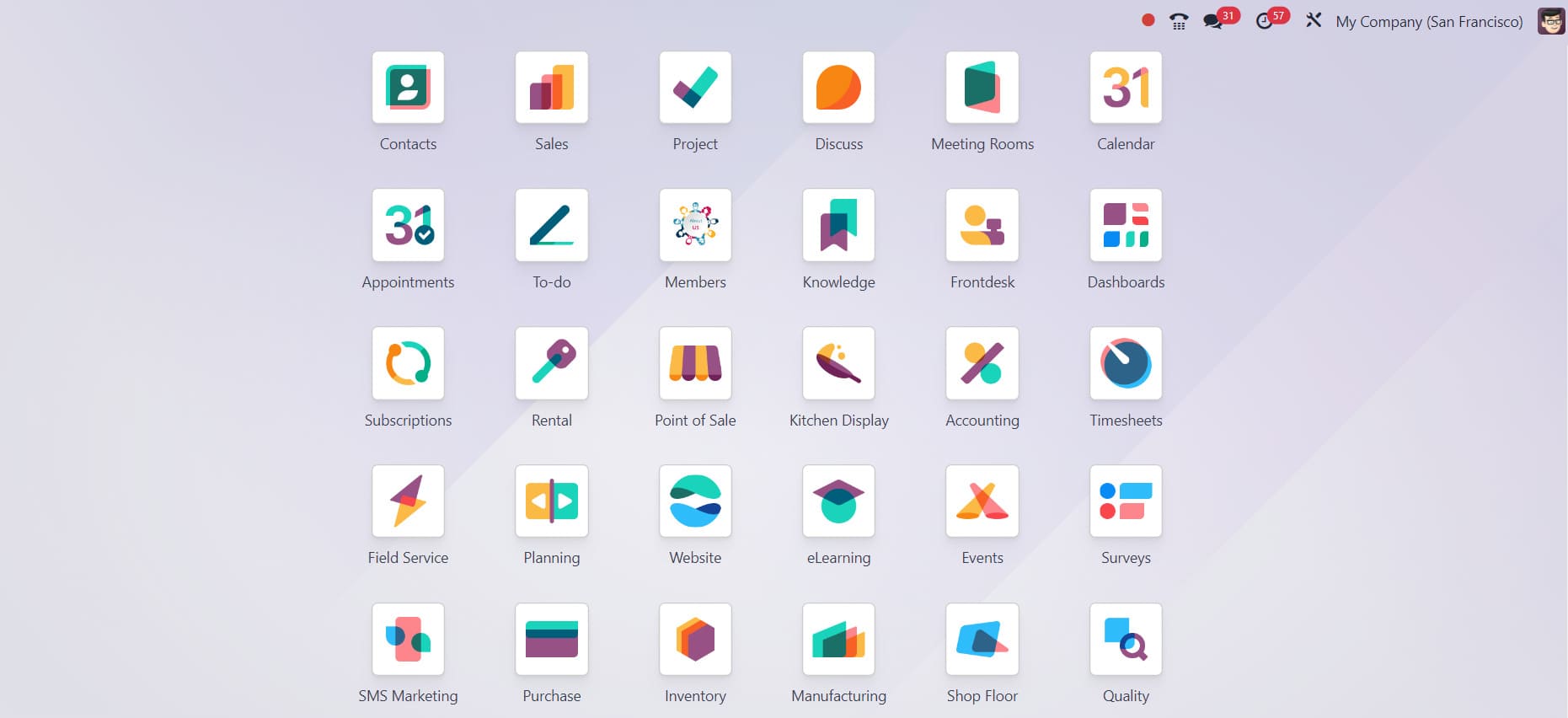
Odoo, an extensive open-source suite of business management tools, boasts a user base exceeding 12 million globally, making it one of the most widely adopted Enterprise Resource Planning (ERP) systems available today. Its comprehensive modules are designed to enhance virtually every aspect of a company's operations. The platform benefits from a vibrant developer community that ensures continuous innovation, development, and support. As an open-source solution, Odoo prioritizes cost-effectiveness and offers unparalleled customization flexibility, allowing businesses to tailor the system precisely to their unique needs. Key features of Odoo’s business management capabilities include robust modules for Sales and Customer Relationship Management (CRM), Inventory and Manufacturing Resource Planning (MRP), Finance and Accounting, Marketing and E-commerce, as well as Project and Human Resources management, among many others.
WordPress
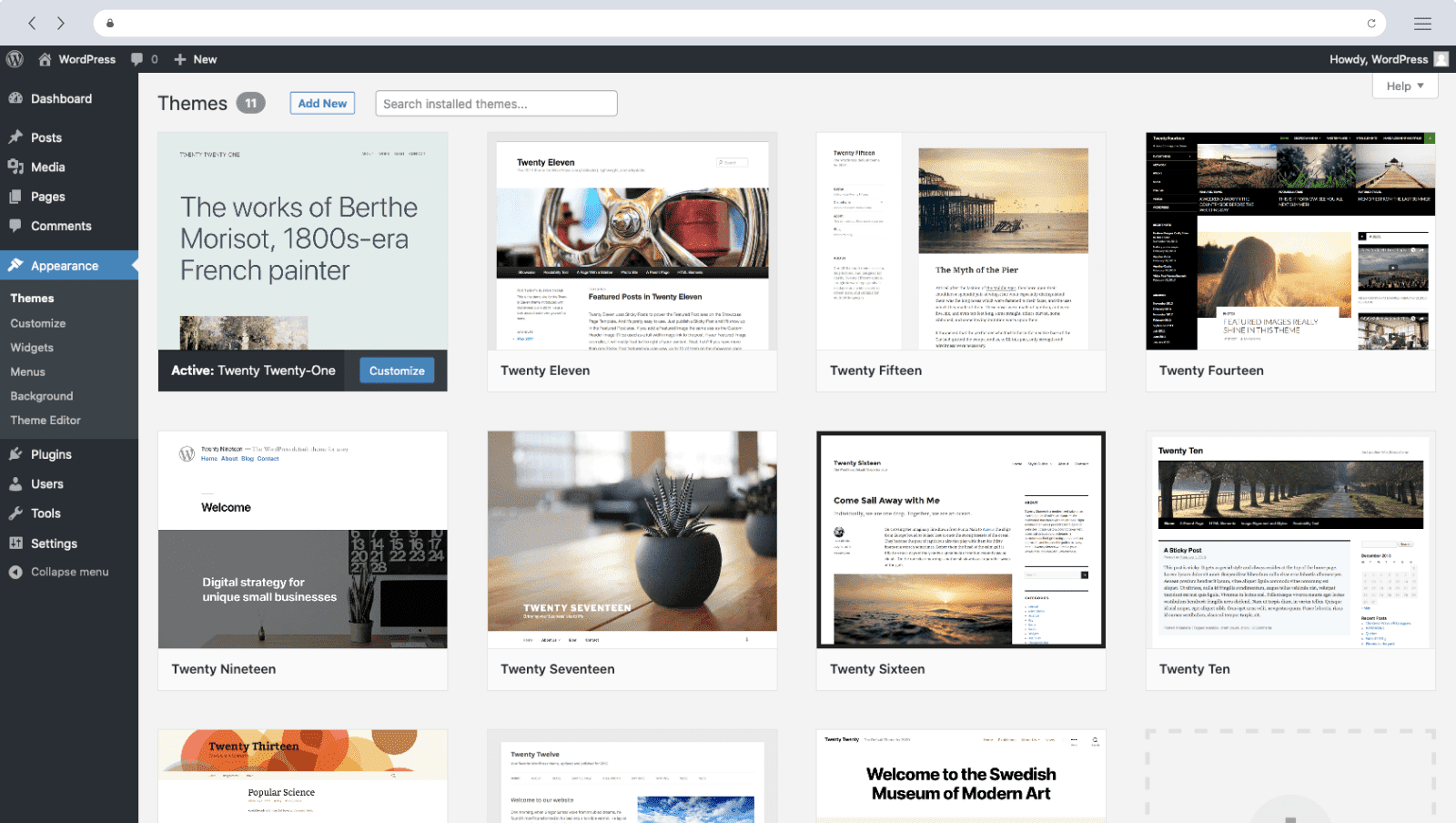
WordPress stands as a leading, free, and open-source Content Management System (CMS) primarily used for creating and managing blogs and websites. Powering over 800 million websites worldwide, it is undeniably one of the most popular and versatile platforms for online presence. Its robust feature set extends beyond basic content management, offering powerful commercial functionalities. These include extensive website function extensibility through plugins, comprehensive marketing and monetization tools, intuitive website design and management capabilities, and various services to optimize website performance. WordPress's widespread adoption is a testament to its flexibility, user-friendliness, and the vast ecosystem of themes and plugins that cater to diverse business requirements.
How Odoo & WordPress Integration Benefits Users
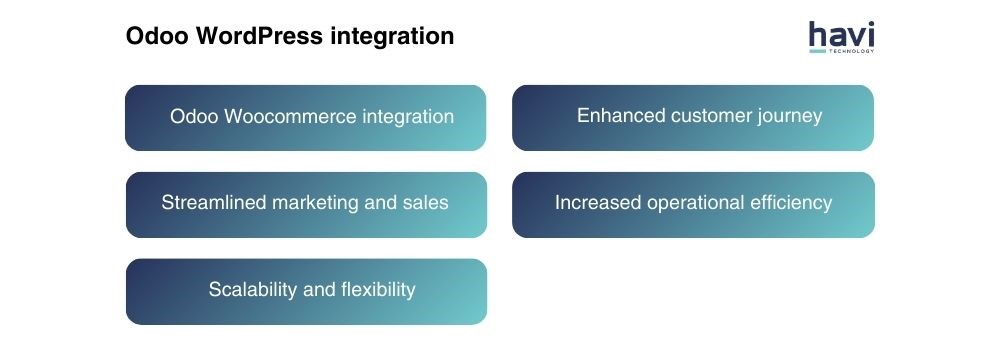
1. Seamless WooCommerce Integration
WooCommerce, a complimentary WordPress plugin, offers immediate capabilities for e-commerce. Imagine managing your entire online business from a singular, authoritative source, encompassing aspects like marketing strategies, customer support interactions, operational workflows, financial management, order processing, and inventory control. This becomes a tangible reality when you leverage both WooCommerce and Odoo in tandem. The integration facilitates critical business functions such as automatic inventory updates, streamlined order processing, and centralized management of sales tax and shipping, significantly simplifying your daily operations. This powerful combination has the potential to accelerate your trajectory toward sustained success, elevate your company's efficiency, and simplify the complexities of e-commerce management.
2. Enhanced Scalability and Flexibility
Both Odoo and WordPress are renowned for their powerful scalability options, allowing your platform to grow and adapt seamlessly alongside your evolving business needs. Odoo's modular architecture provides a comprehensive array of modules designed to meet diverse company requirements, enabling you to add specific functionalities precisely when they are needed. This ensures that your ERP system remains agile and relevant. Similarly, WordPress offers extensive customization through a vast ecosystem of plugins, ranging from sophisticated e-commerce solutions to effective lead capture forms, all designed to accommodate your changing demands. A key advantage is its open API, which facilitates flawless integration with a wide variety of external tools and applications, including Odoo. This inherent flexibility is crucial; it prevents the burden of unnecessary features, making your website highly adaptive and significantly improving resource utilization and overall performance.
3. Elevated Customer Journey
An integrated Odoo and WordPress environment can significantly enhance the customer journey. It allows customers to effortlessly browse products on your WordPress website, transition smoothly to placing orders within Odoo, and manage their transactions with ease. This integration effectively eliminates data silos, providing a more unified and consistent experience that, in turn, boosts customer satisfaction and cultivates loyalty. Odoo’s robust capabilities also support efficient order processing and comprehensive account administration, ensuring timely fulfillment and transparent communication throughout the entire purchasing cycle. Consider the scenario where a customer discovers a product on your WordPress site and then experiences a frictionless in-store checkout process powered by Odoo POS. This seamless connection between your online and offline customer interactions is precisely what this powerful integration delivers, creating a truly omnichannel experience.
4. Streamlined Marketing and Sales
Integrating Odoo and WordPress empowers businesses to strategically enhance their lead nurturing and customer engagement processes. Leads captured directly through forms on your WordPress site can be seamlessly merged into Odoo's CRM system, ensuring no potential customer is overlooked. Furthermore, by providing a unified view of the customer experience, this powerful combination enables your marketing and sales teams to dismantle departmental silos and collaborate more effectively. This cohesive approach broadens your market reach, efficiently develops leads into qualified prospects, and ultimately converts them into loyal, long-term customers.
5. Increased Operational Efficiency
The integration of Odoo and WordPress plays a pivotal role in automating repetitive tasks across various business functions, including lead generation, comprehensive order management, and even sophisticated e-supply chain operations such as inventory and warehouse management. This automation liberates significant time and valuable resources, allowing your team to focus their efforts on achieving strategic goals, fostering deeper customer relationships, and driving innovation. Odoo's inherent automation capabilities are designed to streamline internal operations, while WordPress's content scheduling features can automate content publishing, effectively minimizing human errors and ensuring consistent online presence. Together, these platforms contribute to a more agile, productive, and error-resistant operational framework.
Exploring Common Integration Approaches
Selecting the most suitable integration method for Odoo and WordPress requires a thorough evaluation of your specific business needs, existing infrastructure, and available technical resources. Here, we examine four common approaches to facilitate this powerful connection:

1. Direct API Integration
Direct API integration involves utilizing the Application Programming Interfaces (APIs) provided by both Odoo and WordPress to construct a customized connection. This approach offers the highest degree of flexibility and granular control, allowing businesses to tailor the integration precisely to their unique operational requirements. However, it necessitates a significant level of technical expertise and dedicated development resources. This method is particularly well-suited for organizations with complex business processes, highly specific data synchronization needs, or those seeking a bespoke solution that off-the-shelf options cannot provide.
2. Odoo/WordPress Plugins and Connectors
Plugins and connectors are pre-built, ready-to-use solutions designed to address common integration requirements between Odoo and WordPress. These typically cover functionalities such as product synchronization, efficient lead capture, and streamlined user authentication. Several common options are available:
- Odoo Connector: This type of plugin facilitates basic synchronization for essential tasks, including product data management, lead tracking, and order processing. It is generally straightforward to set up, but it may offer limited custom functionality for more intricate integration scenarios.
- WordPress Connector: Conversely, this type of plugin often includes more advanced features, such as real-time data synchronization, automated workflows, and comprehensive two-way data exchange between the platforms. While requiring a slightly higher level of technical understanding for configuration, it can prove highly effective for more complex integration needs.
- Third-party Plugins: A variety of independent developers offer specialized plugins designed for niche functionalities. These might include connecting specific Odoo modules, such as Odoo CRM, with WordPress forms, or providing highly customized integration procedures. While they offer considerable flexibility, these solutions may require ongoing maintenance and regular compatibility testing to ensure seamless operation.
3. Third-party Tools
Third-party integration platforms, such as Zapier, provide intuitive visual drag-and-drop interfaces that are ideal for users without extensive technical backgrounds. These tools facilitate connections between various applications through pre-built "zaps" or "flows," automating workflows across different platforms. While incredibly user-friendly and efficient for many common tasks, these solutions may present certain limitations when compared to fully custom-developed integrations, especially for highly specific or complex data transfer requirements.
4. Professional Services
Numerous specialized companies offer expert integration services for Odoo, WordPress, and WooCommerce. These professionals manage the entire integration process, encompassing initial setup, meticulous configuration, and ongoing maintenance, thereby ensuring a smooth and efficient experience for the client. This solution is particularly advantageous for businesses that may lack the in-house technical resources or expertise to undertake such an integration themselves. While it represents an additional investment, leveraging professional services guarantees a robust, reliable, and expertly managed integration tailored to your specific operational needs.
Do You Need Both? Critical Considerations for Your Decision
Understanding the context is paramount. Integrating open-source platforms like Odoo and WordPress holds the potential to significantly boost your business capabilities, but it is a decision that demands careful thought and planning. Here’s a clear roadmap to guide you through the selection process before embarking on this journey.
#1 Know Your Needs
Before committing to an Odoo and WordPress integration, it is crucial to thoroughly evaluate your company's current operational landscape. Several key aspects should be considered:
- Your current pain points: Are you struggling with disconnected data across departments, inefficient or manual workflows, or a suboptimal online customer experience? Identifying these core challenges will reveal precisely how an integration could provide meaningful solutions.
- Your business goals: What are your primary objectives? Are you aiming to significantly increase online sales, strengthen customer relationships, streamline internal operations, or expand into new markets? Aligning the integration with these overarching goals ensures that it delivers tangible and impactful outcomes.
- Your existing systems: What other software do you currently use for functions such as marketing automation, accounting, or project management? Understanding your existing tech stack is vital for identifying potential compatibility issues and forecasting the complexity of integrating new systems.
To help you visualize this better, here's a breakdown of who typically stands to benefit most from such an integration and who might be better served by focusing on a single system initially:
Examples of businesses that benefit from both platforms:
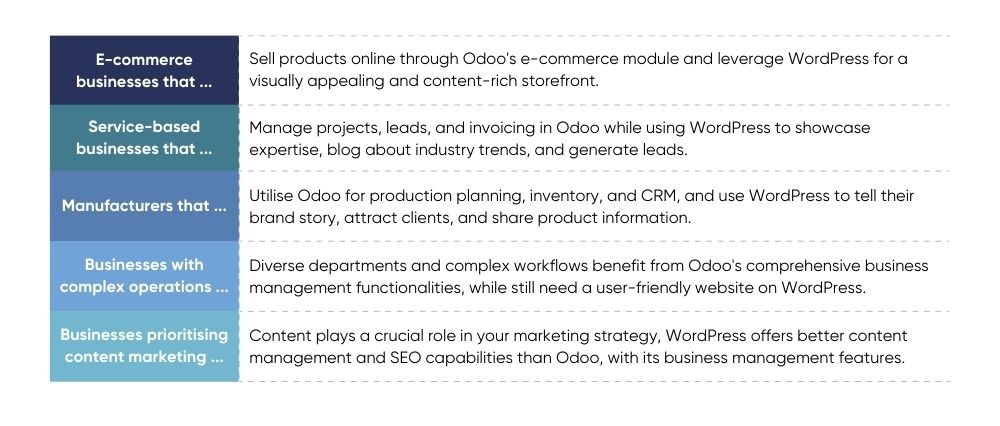
And those who might be better off with one platform first:
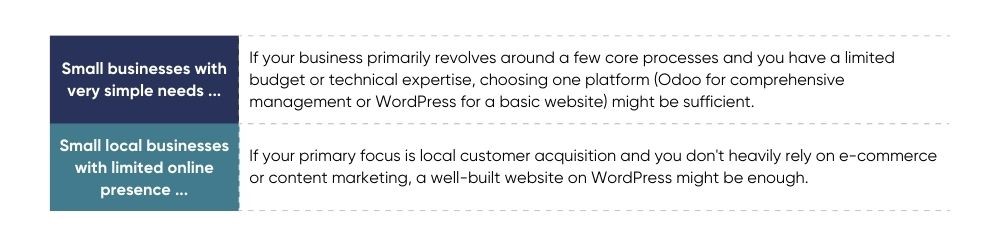
Ultimately, the final decision hinges on your specific business strategy, overarching goals, and available resources. It is imperative to meticulously consider your operational needs, allocated budget, and internal technological capabilities before determining whether to implement both platforms.
#2 Weigh the Pros and Cons
While the transformative potential of integrating Odoo and WordPress is undeniable, a well-informed strategy necessitates a balanced assessment of both the advantages and potential drawbacks. Below, we've outlined some common benefits and limitations to guide your decision-making process:

#3 Consider Your Resources
A careful and honest assessment of your available resources is a critical step in any integration project. This evaluation ensures that the project is not only viable but can also be successfully implemented, efficiently maintained, and effectively supported long-term. Several key aspects demand your consideration:
- Technical expertise: Do you have in-house personnel capable of handling basic troubleshooting, configuration, or even advanced development, or will you require external professional assistance for these tasks?
- Budget: Have you allocated sufficient funds to cover all potential integration costs, including expenses for specialized tools, developer fees, or recurring application subscriptions?
- Time commitment: Are you prepared to dedicate the necessary time for learning, actively managing, and continuously optimizing the integrated systems to ensure they meet your evolving business needs?
#4 Explore Alternatives
Before embarking on a potentially complex integration procedure, it is crucial to thoroughly explore all available options. The primary objective is to identify the most efficient and cost-effective solution that aligns perfectly with your specific business objectives and current resource constraints. Consider the following important questions:
- Can your existing objectives be met simply by enhancing or optimizing your current systems? Sometimes, strategic updates or refined configurations within Odoo or WordPress alone may be sufficient.
- Are there less complicated or more user-friendly integration options available that specifically cater to your immediate requirements? Research readily available plugins or intuitive third-party utilities that might offer a simpler path.
#5 Seek Information and Support
While integrating Odoo and WordPress offers significant potential for transformation, it requires an ongoing commitment to continuous learning and consistent support. Fortunately, you are not alone on this journey. A wealth of resources and collaborative networks are available to empower your progress:
- Engage with other businesses: Connect with companies that have successfully implemented Odoo and WordPress integrations to gain valuable insights from their real-world experiences and best practices.
- Consult online resources: Actively explore dedicated forums, community platforms, and industry blog posts to gather diverse perspectives, find solutions to common challenges, and access expert advice.
- Consider professional assistance: If your project's complexity warrants it, seek guidance from experienced developers or specialized integration consultants. Their expertise can provide customized instructions and ensure a robust implementation.
Ultimately, remember that while connecting Odoo and WordPress can lead to increased efficiency and an enhanced customer experience, it is not a universally applicable solution. It's advisable to start with a focused approach, gradually expanding functionalities as your confidence and understanding grow. Begin by incorporating basic functionalities and then extend them progressively. Crucially, always maintain a clear focus on the overarching benefits and how this integration can actively contribute to achieving your strategic business objectives.
A Strategic Partnership: Is Odoo and WordPress Right for You?
Combining the strengths of Odoo and WordPress is akin to orchestrating a strategic growth plan for your business. From simplifying day-to-day operations to fostering more dynamic stakeholder interactions, the opportunities presented by this integration are undeniably significant. However, successfully navigating the technological complexities inherent in such a project can be challenging.
To ensure a seamless, effective, and impactful integration, it is highly recommended to consider partnering with an experienced service provider specializing in Odoo or WordPress integration. Their invaluable expertise can guarantee a successful deployment that is meticulously tailored to your unique requirements, thereby allowing your team to concentrate on optimizing other critical business benefits. Do not let potential technological hurdles deter you from realizing the full potential of this dynamic combination; instead, explore dedicated integration services designed to bridge these platforms effectively.